The 2007 Census of Agricultural lists Bucks County as 20th in direct sales by farmers to consumers. While this ranking is probably due in part to things like nursery stock, Christmas trees and selling horses for leisure, I've seen a significant increase in the amount of farms offering fresh, healthy food.
My family began visiting Upper Bucks farms for food purchases as a way to support local businesses and do a small part to preserve local farms. More recently, my wife's intense scrutiny of the factory food, in abundance at the large grocery chains has us replacing this mass-produced "food" containing chemicals, petroleum, waste products, byproducts and genetically altered organisms with all-natural products from our "neighbors" family farms. Just like Bucks Countians did in the 17th, 18th and 19th centuries.
The kids enjoy it, too. They learn about responsible agriculture and see hard work first hand. I like to see the organically grown, free-range and grass fed that will be next week's meals - not wonder if the livestock that is to be my dinner was raised in the same conditions as mushrooms.
Here's my list of Upper Bucks farms and markets. Check web sites to confirm seasonal hours and availability.
Bechdolts Orchard bechdoltsorchard.com
2209 Leithsville Road, (Route 212) toward Hellertown
Peaches, pears, apples, plums, nectarines, tomatoes, peppers, honey & many other food products.
Mon & Tue 9:00 to 5:00. Wed - Sun 9:00 to 6:00.
Bolton's Farm Market boltonfarmmarket.com
1005 Route 113 Silverdale
Turkey: parts, sausage, ground, cutlets: chicken, beef, seasonal produce & milk
Mon - Fri 9:30 - 6:00. Sat 9:30 – 5:00.
Maximuck's Farm Market maximucks.com
5793 Long Lane Road Doylestown (near carversville)
Produce, hormone free frozen beef, milk, plants, flowers, bird seed.
Call for hours: 215-297-9894
Meadow Brook Farms meadowbrookfarmsbeef.com
2655 Slifer Valley Road, Riegelsville (near Pleasant valley)
Beef - ground, steaks, roasts, specialty cuts No hormones, no antibiotics
Fri 9:00 am to 6:00 Sat 9:00 am to 4:00 Sun 11:00 am to 4:00.
Ottsville Farmers' Market ottsvillefarmersmarket.com
8230 Easton Road Ottsville (Route 611 - Linden Hill Gardens)
Fridays 4:00 - 8:00 PM
Penn Vermont Fruit Farm
113 Rolling Hills Rd, Bedminster, PA
Many fruits, produce, honey, syrup & cider.
For hours and availability check their Facebook page
Trauger's Farm Store traugers.com
Route 611 & Island Rd. Kintnersville
Many kinds of fruit & vegetables, baked goods & other products.
Mon - Fri 9:00 - 6:00. Sat & Sun 9:00 - 5:00
Windy Springs Farm windyspringsfarm.com
Market on Rte. 663 east of turnpike, Quakertown
Many kinds of produce, beef, chicken & eggs.
July through Mid October, every day 9:00 - 6:30.
Klein Farms Dairy and Creamery kleinfarms.zxq.net/index.htm
410 Klein Rd, Easton, PA. This is not in Bucks County, it's in Northampton County above Easton (Northampton County used to be the northern part of Bucks until 1752 and it's worth being listed here).
Raw milk, cheese, yogurt, smoothies,beef, some seasonal produce, some baked goods. My kids and I like visiting their variety of animals.


11/30/2012
Desolate Danneltown
Several times each week, I drive through part of Haycock Township on Stoney Garden Road. Mostly forest and many boulders, there's not too much that catches my attention. There's a few old houses, including a well-preserved log home near Potters Lane. There's a handful of not-so-old homes, spaced randomly in isolated clearings. There's a tiny old schoolhouse, at the corner where I turn off onto Roundhouse Road. Near that intersection, there also used to be a pottery in the 19th century. Further east, on both sides of Stoney Garden Road, between Reed Lane and Potter lane, there once was a small hamlet called Danneltown. Some records list it as Danielstown and Danielsville.
Some time before 1850, two brothers, Hiram and Jesse O'Dannel emigrated from Ireland and chose home sites just north of Haycock mountain. They didn't purchase the land and would be considered by today's vocabulary as squatters. But, this was likely unclaimed land as it was unsuitable for any cultivation and they were able to obtain titles. On a township map of 1850, the home sites of H. O'Dannel and J. O'dannel are shown on the south side of Stoney Garden Road, where it crosses the smaller hump of Haycock Mountain, also called “Little Haycock”.
Some time before 1850, two brothers, Hiram and Jesse O'Dannel emigrated from Ireland and chose home sites just north of Haycock mountain. They didn't purchase the land and would be considered by today's vocabulary as squatters. But, this was likely unclaimed land as it was unsuitable for any cultivation and they were able to obtain titles. On a township map of 1850, the home sites of H. O'Dannel and J. O'dannel are shown on the south side of Stoney Garden Road, where it crosses the smaller hump of Haycock Mountain, also called “Little Haycock”.

After the O'Dannel brothers settled and built their small log homes, others came and built more modest log "huts" in the immediate area. Supposedly they were mostly Irish immigrants, perhaps drawn to the area to work on the Delaware canal. Although, the descriptions of the homes and inhabitants indicate there may not have been a significant source of income. Written accounts imply that the residents seem to be a little "rough". Other than an obituary, county records show nothing of the hamlet, but names of residents of Danneltown occasionally appear in court dockets.

Danneltown was not like the remaining historic villages we see in Upper Bucks. First, it wasn't at any major crossroad. Second, it didn't have a post office, general store, tavern, merchant shop or fine homes. There are very few first hand accounts of the village, but they all have a common description. These describe the village as a group of squalid shacks. In General Davis' A History of Bucks County, he describes it as "a rude hamlet called Danielsville".
John Rogers, a local newspaper writer for the Democrat and Inteligencer described Danielstown and Desolation:
John Rogers, a local newspaper writer for the Democrat and Inteligencer described Danielstown and Desolation:
"Now our words for it, and we will wager our pile on its truthfulness, that as far as you have traveled, or as many miles you've been, this hamlet wins the premium in the poverty-stricken line; as it was long noted upon the criminal records of our county to be without a peer in the calendar of crime and promiscuous general worthlessness".In Place Names in Bucks County, the author George MacReynolds describes:
"Dannelstown was a self-existent community, with tragedy (perhaps sometimes a little roguery) alternating with festivity."Unfortunately, the hamlet and it's buildings where completely gone by the 1920s.
4/16/2011
The Quakertown and Eastern Railroad
The Quakertown and Eastern Railroad (also called the "Quick and Easy" by the locals) was a single-track line that ran from Quakertown to Riegelsville. Construction began on the line a month after it was chartered in July of 1896. Exactly a year after construction commenced, passengers and cargo began being transported from where it branched off the Philadelphia and Reading Railway Company's Bethlehem line in Quakertown to Richlandtown. It was another year until service was available to Springtown. Then another year until it reached the Durham Iron Works. Records then show it took exactly two years to make it the remaining short distance to Riegelsville. The original plan was to extend the line to Easton and connect with the Lehigh and Hudson River Railway, creating a shorter route from Philadelphia to New York State.
The first locomotives to pull cars on this line were from the Philadelphia and Reading Railway Company. In 1903, the Quakertown and Eastern Railroad purchased their own locomotive on installments. 10 months later, they had to trade it in for a smaller model. It frequently derailed because it was too long for some of the tight curves.

Between Quakertown and Richlandtown, the Right of Way (ROW) isn't very clear today, due to commercial buildings, a couple housing developments and woods.
In Richlandtown, it looks like the tracks used to pass behind the Post Office at Pumping Station Road and crossed Richlandtown Pike at about the 7-11 parking lot. I can't find any sources indicating where the Richlandtown station would have been. I'm thinking it may have been where the line crossed Union Street right by where the propane company tore down the neat, weathered old wooden building to build a big ugly steel box.
The next station was Pullen, just north of where the line crossed Pullen Station Road at the S-curve. The long driveway to the northeast is the old ROW. Less then a mile from Pullen Station, where Cooks Creek turns to the northeast, the line begins following the creek. It crossed Old Bethlehem Road just after Bridge Street in Pleasant Valley, before the Three Arch Bridge over the creek. There was also a Pleasant Valley station, but I don't know that location either.
The next station to the northeast was named Gehman and was probably near where the line and Cook's Creek cross Slifer Valley Road. near where the creek and the line crossed Rt 412/212, east of Springtown, is probably the Location of the Springtown Station.
Cooks Creek and the rail line then turn more Easterly and somewhere, about halfway between Springtown and Durham Village, is Witte Station. It was likely near where the Haupt's Mill covered bridge once spanned the creek. It was sometimes called Witte's Bridge. There was likely a station at the old Durham Village, as well.
Between Durham Village and Durham Iron Works, the line crossed the creek twice and some of the stone bridge piers still stand in the creek. After Durham furnace, the line turns North and continues to Riegelsville station.

The Quakertown and Eastern Railroad operated until 1906. This end date corresponds with, and is likely related to, the demise of the Durham Iron Works. Pennsylvania Eastern Railroad took over operations but ceased in early 1907. The locomotive was repossessed by the manufacturer. The cars were collected by the Philadelphia and Reading Railway Company, who also removed the switches to the line in Quakertown.
This wasn't the end of this railroad though. It was revived for service to Upper Bucks County a few more times and that will be the subject of my next post.
 |
| Q & E's original engine Engine No.1 in 1903. |
The first locomotives to pull cars on this line were from the Philadelphia and Reading Railway Company. In 1903, the Quakertown and Eastern Railroad purchased their own locomotive on installments. 10 months later, they had to trade it in for a smaller model. It frequently derailed because it was too long for some of the tight curves.

After leaving the Quakertown station and shortly after crossing Broad Street to the north, the Q&E, branches off the Bethlehem line and heads northeast. Across the tracks from the rear of the Borough building, you can see a short section of the abandoned rails, but the interchange switch is long gone.
Between Quakertown and Richlandtown, the Right of Way (ROW) isn't very clear today, due to commercial buildings, a couple housing developments and woods.
In Richlandtown, it looks like the tracks used to pass behind the Post Office at Pumping Station Road and crossed Richlandtown Pike at about the 7-11 parking lot. I can't find any sources indicating where the Richlandtown station would have been. I'm thinking it may have been where the line crossed Union Street right by where the propane company tore down the neat, weathered old wooden building to build a big ugly steel box.
 |
| View from Bridge Street in Pleasant Valley, showing the ROW curve sloping down to the crossing of Old Bethlehem Road. |
The next station to the northeast was named Gehman and was probably near where the line and Cook's Creek cross Slifer Valley Road. near where the creek and the line crossed Rt 412/212, east of Springtown, is probably the Location of the Springtown Station.
Cooks Creek and the rail line then turn more Easterly and somewhere, about halfway between Springtown and Durham Village, is Witte Station. It was likely near where the Haupt's Mill covered bridge once spanned the creek. It was sometimes called Witte's Bridge. There was likely a station at the old Durham Village, as well.
Between Durham Village and Durham Iron Works, the line crossed the creek twice and some of the stone bridge piers still stand in the creek. After Durham furnace, the line turns North and continues to Riegelsville station.
 |
| 1900 Bucks County map, showing the entire Q & E line and stations. |

The Quakertown and Eastern Railroad operated until 1906. This end date corresponds with, and is likely related to, the demise of the Durham Iron Works. Pennsylvania Eastern Railroad took over operations but ceased in early 1907. The locomotive was repossessed by the manufacturer. The cars were collected by the Philadelphia and Reading Railway Company, who also removed the switches to the line in Quakertown.
This wasn't the end of this railroad though. It was revived for service to Upper Bucks County a few more times and that will be the subject of my next post.
9/28/2010
Bedminster Township
 Mention Bedminster township and I immediately picture driving along quiet country roads with long views of beautiful farmland and through a few tiny, historic hamlets. It's located "below the lake" to those of us that live north of Lake Nockamixon, right in the middle of the northern half of the county. Tinicum creek is its northern and eastern border and the lake was created by damming the creek in the northwest corner of the township. The northern border actually extends to the creek bed out in the middle of the lake. The western edge follows the Old Bethlehem road from where it's submerged in the lake to route 313. The line then turns southeast and follows route 313 down to and around Dublin. The final border runs northeast and follows Applebutter road from Dublin to just above Plumsteadville, then it continues northeast along Township Line Road to Durham Road. The line then continues this same direction all the way east to Tinicum creek, just below Stover-Myers Mill.
Hagersville and Keelersville are small villages on the Old Bethlehem road, a major stage coach route. Hagersville, south of Ridge road at one time had two coach factories, a wheelwright and blacksmith, a store and the Hagersville Hotel. Keelersville, just north of Ridge Road had several shops, a store, a tannery and leather factory, and also had a hotel.
Pipersville is the most visible village due to its location at the northern termination of route 413 at 611, near the eastern corner of the township. It's the home of the Piper Tavern, having a long history dating back to the original building's construction date of 1759. This village, being located at the merge of the old Durham road and the Philadelphia-Easton Post road also had a store, post office, chapel, library (still there) and a large clothing factory.
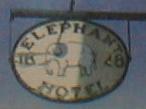 Elephant is a hamlet of only two homes and the old Elephant Hotel, built in 1848. It is at the intersection of Ridge and Elephant roads. The hotel is currently undergoing a major renovation. The original hotel sign hangs in the mercer museum in Doylestown.
Deep Run is not a village or hamlet, but a large area with historic significance to the township. Deep Run creek runs across most of the southeastern part and flows into the Tohickon just above Pipersville. The first settlers to the area were "Scotch-Irish" and settled in the creek valley. The inhabitants of "Deep Run Territory" petitioned to form a township in 1742, which was named Bedminster. Many of the original settlers moved out of the area and "German" Mennonites Purchased much of the land, mostly for farming. This area of Bedminster township is home to the historic Presbyterian "Irish Meeting House", the Deep Run East and Deep Run West Mennonite meetinghouses and the well-preserved "German school".

There are other smaller streams that include Cabin Run, Deer Run, Wolf Run, Mink Run, that flow east to the Tohickon and the beginning of the East Branch Perkiomen Creek that flows west. At one time there were numerous mills along some of these creeks, and some creameries, serving the needs of the farmers in the township.
Subscribe to:
Posts (Atom)